Opsmith


Opsmith turns production signals and source code into reviewed pull requests.
It watches your logs, metrics and repositories, links what production shows to what the code shows, and ranks the result as engineering tasks. When a human approves a task, a sandboxed coding agent implements it and opens a pull request. After a human merges it, Opsmith checks that the original problem is actually gone.
It is for teams that run their own services and want fixes proposed from production evidence, with a person deciding every change. It is self-hosted and not tied to a model vendor: it runs offline with built-in rules, with Claude, or with any OpenAI-compatible endpoint, including local models served by Ollama or vLLM. With a model, it can also carry out review instructions of your own on a schedule, such as "audit this code for bugs and performance issues" (checks).
Two rules are never broken. Nothing changes code without a recorded human approval, and Opsmith cannot merge. A human always merges.
Status: stable, not yet proven in production. Releases follow semantic versioning; see the latest release and the changelog. The whole loop runs and is covered by tests, including adversarial ones and real-container sandbox tests. See what has been tested before you point it at something valuable.
Contents
- See it work in a minute
- How it works
- Quickstart
- Safety at a glance
- What has been tested
- Documentation
- Contributing
See it work in a minute
You need uv and git. No API key and no Docker; once installed, the demo runs without network access.
git clone https://github.com/deadboyccc/Opsmith.git && cd Opsmith
uv sync --all-extras
uv run opsmith demo --dir ./opsmith-demo
The demo builds a small repository with a real bug, feeds in logs and metrics, and runs the entire loop with the offline rule-based provider:
- First analysis run: a burst of timeout errors becomes open leads (things worth watching).
- Second run: the timeout lead is confirmed, using context carried over from the first run, and a latency regression is found.
- Repository audit: finds an HTTP call without a timeout on the same line the errors point at. The runtime finding and the code finding merge into one task.
- A reviewer approves the task. The agent fixes the code, and the repository's build, lint and test pass.
- A pull request opens, a human merges it, and the task ends
verified.
It prints an admin API key. Use it to look around in the UI:
OPSMITH_DATA_DIR=./opsmith-demo/data uv run opsmith api
# open http://127.0.0.1:8000/ui and sign in with the admin key the demo printed
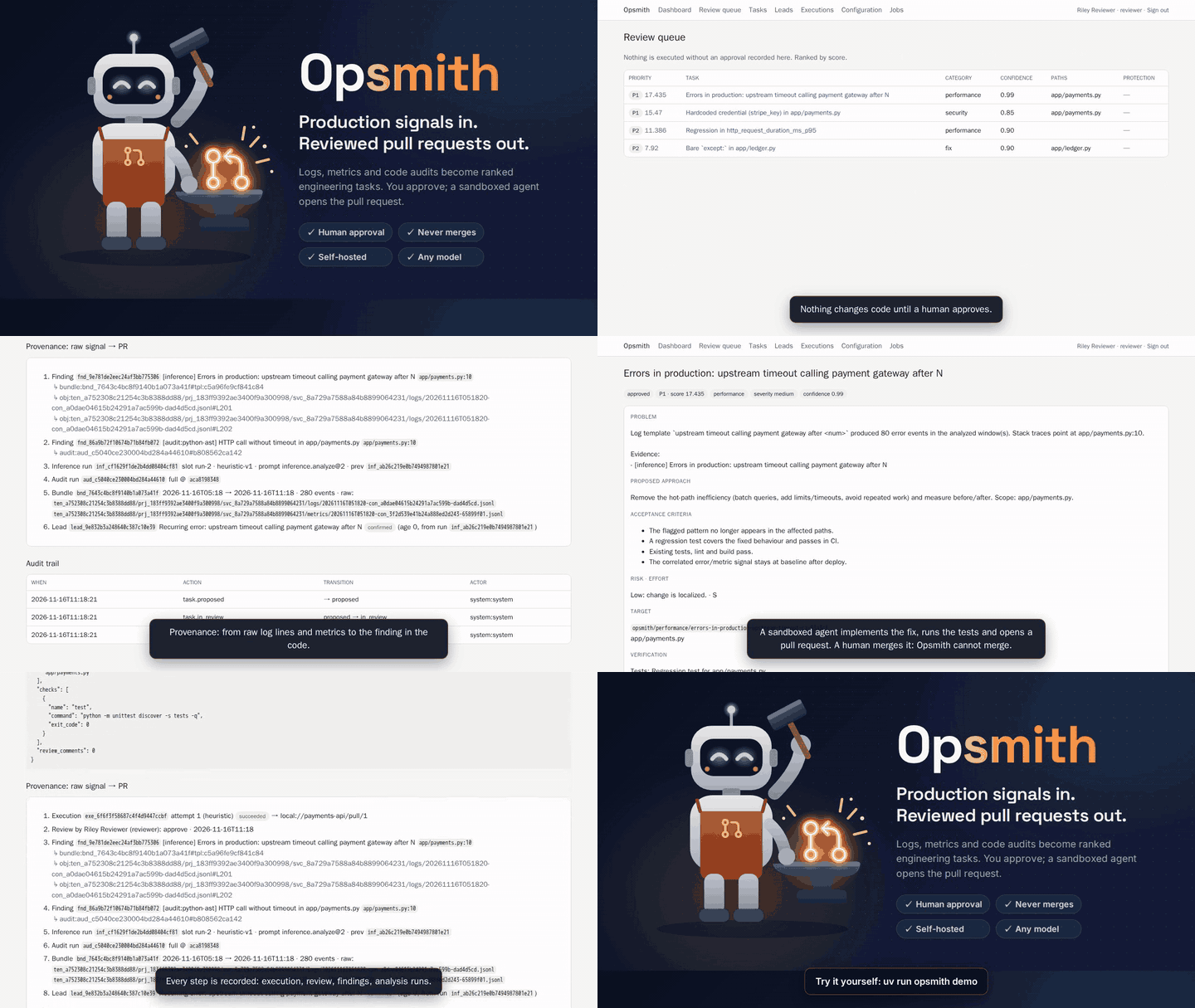
Here is the demo in one minute, with a reviewer approving in the UI (full-size MP4, with music; all data is synthetic; more pages in the UI tour):
Or the 30-second version, vertical, for sharing on phones (reel.mp4, 1080 x 1920, with music):
How it works
One loop: observe → analyze → propose → human approves → execute → pull request → verify.
flowchart TB
    subgraph FIND["Find problems (automatic, read-only)"]
        direction LR
        SIG["Logs + metrics"] --> ETL["1 · Ingest<br/>normalize, redact, bundle"]
        ETL --> INF["2 · Analyze<br/>every few hours,<br/>carries open leads forward"]
        REPOS["Repositories"] --> AUD["3 · Audit<br/>scanners + triage"]
    end

    subgraph DECIDE["Decide (always a human)"]
        direction LR
        AGG["4 · Aggregate<br/>correlate, dedup, rank"] --> REVIEW{{"5 · Human review"}}
    end

    subgraph FIX["Fix (only after approval)"]
        direction LR
        EXEC["6 · Sandboxed agent<br/>edit, test, gate"] --> PR["7 · Pull request + CI"]
        PR -- "a human merges" --> VERIFY["8 · Verify<br/>is the signal gone?"]
    end

    INF --> AGG
    AUD --> AGG
    REVIEW -- "approve" --> EXEC
REVIEW -. "ask for more investigation" .-> INF| # | Stage | What happens | Produces |
|---|---|---|---|
| 1 | Ingest | Connectors pull or receive signals. They are normalized, redacted, grouped into log templates and metric baselines | Compact bundles per service and time window |
| 2 | Analyze | Per service, a model of your choice reads the new bundles plus the open leads from the last run, and confirms, refutes or carries each lead | Findings and updated leads |
| 3 | Audit | On a schedule: secrets, Python bug and security checks, dependency and license checks, your own policy rules, external scanners when installed, and checks: your own review instructions, carried out by a model | Findings with code locations |
| 4 | Aggregate | Findings that point at the same code are merged, checked against open, recently closed and rejected tasks, then scored | Ranked tasks |
| 5 | Review | A person approves, approves with edits, rejects with a reason, defers, or asks for more investigation | A recorded review |
| 6 | Execute | An isolated agent edits the checkout and runs the repository's build, lint and test. Opsmith re-runs build, lint and test and blocks unsafe diffs | A tested commit on a new branch |
| 7 | Pull request | Opsmith pushes the branch and opens a PR that carries the evidence, the checks and links back to the task | A PR; CI is tracked |
| 8 | Verify | After the merge, Opsmith watches the original signal | verified or regressed |
Every arrow is a queued, retried job. A failure never vanishes: it ends as a visible dead job with a notification, or as a task back in the review queue with a report.
What makes a task strong is evidence from both sides. Eighty timeout errors whose stack
traces point at app/payments.py:10, plus an audit finding for an HTTP call without a timeout
on that line, become one task with higher confidence than either alone. Every pull request can
be traced back: PR → execution → review → task → findings → evidence → analysis runs → leads.
The seven terms above (signal, bundle, lead, finding, task, review, execution) and the lifecycles of leads and tasks are explained in Concepts.
Quickstart
Your own project, on your machine
Getting started walks through it step by step: set up a project for a repository of yours, send it logs, and get your first task and pull request. It takes about fifteen minutes and needs no API key and no Docker, and no network once installed. In short:
export OPSMITH_LOCAL_ROOT=$HOME/opsmith-lab     # the one directory Opsmith may read repos and files from
export OPSMITH_DATA_DIR=$HOME/opsmith-lab/data
export OPSMITH_SANDBOX_BACKEND=local            # development only: no isolation, local repositories only

uv run opsmith init --tenant lab --admin "You"            # prints an admin API key, shown once
uv run opsmith apply opsmith.toml --tenant lab            # your project; see the guide for the file
uv run opsmith run                                        # API + scheduler + worker in one process
Then open http://127.0.0.1:8000/ui.
The full stack (Docker Compose, PostgreSQL)
cp .env.example .env
echo "POSTGRES_PASSWORD=$(openssl rand -hex 24)" >> .env    # required; there is no default
docker compose up -d --build
docker compose exec api opsmith init --tenant acme --admin "Your Name"
This runs the API, a worker, the scheduler and PostgreSQL. To let it execute approved tasks you also choose a sandbox, which is a deliberate step: Deployment explains the options and the trade-offs, and how to connect a GitHub repository.
The model you want
Out of the box Opsmith uses built-in offline rules. To use a real model, point it at any OpenAI-compatible endpoint (OpenAI, Azure OpenAI, Ollama, vLLM, LiteLLM, ...) or at Claude, and pick a model per stage. Models has the three-line setups.
Command line
| Command | Purpose |
|---|---|
opsmith demo --dir DIR |
Run the whole loop offline |
opsmith init --tenant NAME --admin NAME |
Create the database, a tenant and its first admin |
opsmith create-user --tenant NAME --name NAME --role ROLE |
Create a key for a person or a collector |
opsmith apply FILE --tenant NAME |
Apply a project configuration file (safe to repeat) |
opsmith api / scheduler / worker |
The three production processes |
opsmith run |
All three in one process, for development |
Safety at a glance
| Guarantee | How it is enforced |
|---|---|
| No code change without human approval | One gate checks the approval before the run and again before the push. The approval covers exactly the task the reviewer saw: if its scope changes afterwards, the approval is void |
| No merge | The SCM interface has no merge operation |
| Redaction before any model call | Signals are redacted when stored and again in the gateway every model call goes through |
| Untrusted text stays data | Logs, code and model output are never instructions; model output is schema-checked and invented references are dropped |
| Isolated execution | Repository commands run in containers with no network, a read-only root and no capabilities. The agent has no shell and no credentials. The unconfined development sandbox is refused for real repositories |
| Gated diffs | Protected paths need an elevated approval or are excluded outright; credential-like values block the PR. The gates run after the last sandboxed command |
| Least privilege | Connectors only read. Opsmith pushes only to opsmith/... branches and opens PRs |
| Budgets | Token and cost caps per run and per project per day; time and iteration caps for the agent |
| Audit trail | Every state change and decision is recorded; finished analysis runs are immutable |
Each of these is mapped to its enforcement point and to the tests that try to break it in Security, together with the limits you should know about. The last security audit records what was looked for, what was fixed and what is still open.
What has been tested
Honest scope, so you can judge it:
| Area | Evidence |
|---|---|
| The full loop | tests/test_e2e.py asserts the specification's acceptance criteria end to end, on SQLite and on PostgreSQL in CI |
| Safety gates | tests/test_hardening.py and friends attack each guarantee: approval binding, gate bypasses, sandbox escapes, cross-tenant access, role escalation |
| Docker sandbox | Tested with real containers (network, filesystem, capabilities, timeouts, and a full execution). Skipped automatically where Docker is absent |
| Compose deployment | Built and started end to end by hand before 1.0.0, including the worker starting sandbox containers through the overlay. CI builds both images and validates the Compose files on every push, but does not start the stack |
| Documentation | Every command in Getting started was run as written. A check in CI compares the docs with the code: links, cited tests, environment variables, settings, API endpoints, events, connector types, states and commands |
| Coverage | 94.5% of lines and branches. CI fails below 93%, and audits the locked dependencies for known vulnerabilities on every push |
| Loki, Prometheus | Run against real servers in CI on every push: Loki 2.9 and 3.7, Prometheus 2.53, 3.5 and 3.16. See the compatibility matrix |
| VictoriaLogs | A scripted server in CI on every push; run by hand against a real VictoriaLogs 1.53 server. Not yet live in CI |
| GitHub | Tested against mocked HTTP only. Not yet exercised against github.com in CI |
| Models | The offline rule-based provider drives the tests and the demo. The whole acceptance scenario also runs through the OpenAI-compatible HTTP path against a scripted endpoint and must end identically (tests/test_provider_parity.py). That provider and its coding agent were also run live against Ollama with a small open model, and a workflow repeats that weekly. Claude is tested with the real Anthropic SDK over a mocked transport, not against the Claude API |
| Checks | Tested through the real gateway with a scripted model, including the adversarial cases (invented findings, code posing as the instruction, files that must not be sent). Not yet run against a live model in CI |
| Production use | None yet. No load tests, no long-running deployment |
There are no published quality metrics yet (precision of findings, share of pull requests merged, verified-fix rate). That is the main open work; see the changelog, the review response and the open findings of the security audit.
Documentation
All of it is also published as a website, with search, at https://deadboyccc.github.io/Opsmith/. The full index is in docs/README.md. The pages are split by reader.
Using Opsmith
| Page | Read it to |
|---|---|
| Getting started | Go from a fresh clone to your own project's first pull request |
| UI tour | See what it looks like |
| Concepts | Understand the terms, the pipeline and the lifecycles |
| Configuration | Describe projects: repositories, connectors, budgets, protected paths |
| Checks | Write review instructions that a model carries out on a schedule |
| Models | Use offline rules, any OpenAI-compatible endpoint, or Claude |
| Deployment | Install it for real: Compose, the sandbox, GitHub, environment variables |
| Operations | Monitor, upgrade and troubleshoot it |
| API | Authenticate, understand roles, call the REST API |
| Security | Know what is guaranteed, which test proves it, and what is not protected |
| Security audit | See what the last audit found, what was fixed and what is open |
| Compatibility | See which versions of Loki, VictoriaLogs, Prometheus and the rest are verified, and how |
Developing Opsmith
| Page | Read it to |
|---|---|
| CONTRIBUTING.md | Set up, make a change, open a pull request |
| AGENTS.md | Learn the invariants and conventions (for people and AI coding agents) |
| Architecture | Understand the internals and the plugin points |
| Testing | Run and write tests |
| Architecture decisions | See why it is built this way, and the known limitations |
| Decisions | See how individual fixes and tooling choices were decided |
| Changelog | See what changed |
Contributing
uv sync --all-extras
make check        # ruff, format check, mypy, tests with a coverage floor, docs links
make audit        # known vulnerabilities in the locked dependencies (needs network)
Start with CONTRIBUTING.md. It is short.